
Brushing your teeth - Toothpaste tablets instead of toothpaste
Have you ever brushed your teeth with toothpaste tablets? Or do you need more information on why you should look beyond the tube? If so, you've come to the right place!
In this article, you will learn what sets tablets apart from conventional toothpaste and the benefits they offer for your oral hygiene. First, you can take a brief look at the history of Denttabs, the pioneers and originals among toothpaste tablets.
A dental care product without water and yet as effective as toothpaste?
Is that possible? Like many great discoveries and inventions, the history of Denttabs toothpaste tablets is based on a chain of different circumstances.
The Denttabs story goes like this:
In 1998, a dentist was tasked in his doctoral thesis with finding out whether it was possible to produce a dental care product without water that cleaned just as well as normal toothpaste. The future founder of Denttabs, Axel Kaiser, heard about it and took on the project by actively supporting the doctoral thesis in practical terms. End of story! Almost. Because although the result was a granulate that was in no way inferior to a classic toothpaste in its care effect, it still took another five years of development work until the first Denttabs for brushing teeth came onto the market in 2003. The official founding of "Denttabs innovative Zahnpflegegesellschaft mbH" took place in 2009. Since 2019, Denttabs toothpaste tablets have also been available in environmentally friendly, plastic-free packaging.
What distinguishes toothpaste tablets from toothpaste?
The most important difference right from the start: tablets for brushing teeth manage with a minimum of ingredients. A conventional toothpaste not only contains significantly more, but also some that are considered quite questionable chemicals – even if they are initially considered harmless for the body in low doses.
Conventional toothpaste contains up to 50% water
Consequently, a tube of toothpaste contains a large number of preservatives. These are used, among other things, to prevent the formation of mold, etc. Denttabs toothpaste tablets, on the other hand, consist of 0% water and about 70% small, finely ground cellulose fibers. These ensure that the teeth are not only cleaned when brushing, but also polished in a way that is gentle on the teeth.
What Denttabs toothpaste tablets do NOT contain, unlike toothpaste:
- Preservatives
- Parabens
- Aluminum
- Bleaching agents and artificial colors
- Questionable surfactants for foam generation
- Petroleum-based polyethylene glycols (PEGs)
- Titanium dioxide
Since Denttabs are manufactured without water, the use of the additives listed above is not necessary at all, as they do not offer any advantages in terms of dental health. Also, the production of PEGs, parabens, etc. is already known not to be particularly environmentally friendly or resource-saving.
No foam in your mouth? The Denttabs chewable tablets contain only a few surfactants because:
The foam that is created when brushing teeth with toothpaste due to the use of mostly aggressive surfactants does not, as is often assumed, provide a better cleaning effect or oral hygiene. Rather, the formation of foam when brushing teeth is intended to evoke a positive feeling of "special cleanliness." However, some surfactants are suspected of having an unfavorable influence on the oral mucosa. In this regard, the widely used surfactant sodium lauryl sulfate (SLS) is particularly controversial.
Another disadvantage of surfactants is their irritating effect on the oral mucosa. This can manifest itself, among other things, through a spongy gum structure or an increased formation of aphthae in the mouth.
Since our tablets do not use aggressive surfactants, the foam development is, so to speak, naturally curbed. But don't worry: your teeth will become super smooth and clean even without a lot of foaming.
All benefits of Denttabs at a glance:
- Microplastic-free
- Natural and vegan ingredients
- Certified natural cosmetics
- Available with and without fluoride
- Environmentally and resource-friendly production
- Practical and easy to take with you
- Compostable packaging
Quote: "Unlike conventional toothpaste, Denttabs toothpaste tablets contain no aggressive abrasives."
What abrasives in conventional toothpaste do
Primarily, the abrasives are intended to ensure clean teeth. However, they have an abrasive effect. This means that sooner or later the enamel can be attacked. Subsequently, abrasives can also be responsible for exposed tooth necks. Small cracks or gaps in the enamel are the most common reasons why teeth react sensitively to cold, heat, or acid stimuli. Denttabs toothpaste tablets polish your teeth gently without attacking the enamel.
Are toothpaste tablets just as good for your teeth as toothpaste?
Our tablets for brushing teeth are not only produced in a resource- and climate-friendly manner with a minimum of ingredients, but also represent a better option than conventional toothpastes in terms of dental health: Because the natural cellulose fibers ensure smooth tooth surfaces without attacking the enamel. As a result, bacteria and tartar find little "surface area" to be able to settle permanently.
13 clinical studies and 6 laboratory reports confirm the effectiveness of Denttabs
Due to numerous investigations, Denttabs toothpaste tablets are among the most thoroughly researched dental hygiene products of all. You can read more about the test results of our toothpaste tablets here.
How are the Denttabs tablets used correctly?
They are very easy to use: Take 1 tablet in your mouth per brushing session and chew it. Mixing it with saliva creates a fine consistency that you pick up with your toothbrush and 'brush' your teeth as usual. Then simply rinse with water and you're done! The first few applications may feel a bit unusual due to the consistency. This is completely normal because, as mentioned, our toothpaste tablets do not contain any foam-forming surfactants.
Are fluorides necessary in toothpaste tablets?
For caries prophylaxis, the German Society for Preventive Dentistry (DGPZM) recommends brushing your teeth twice a day with a fluoride-containing dental care product in order to achieve the most complete removal of the bacterial biofilm possible. In the Cosmetics Regulation, a limit of 1500 parts per million (ppm) of fluoride content in toothpastes was set for this purpose. Our mint tablets therefore contain an optimal value of 1450 ppm fluoride.
Which toothbrush is best suited for toothpaste tablets?
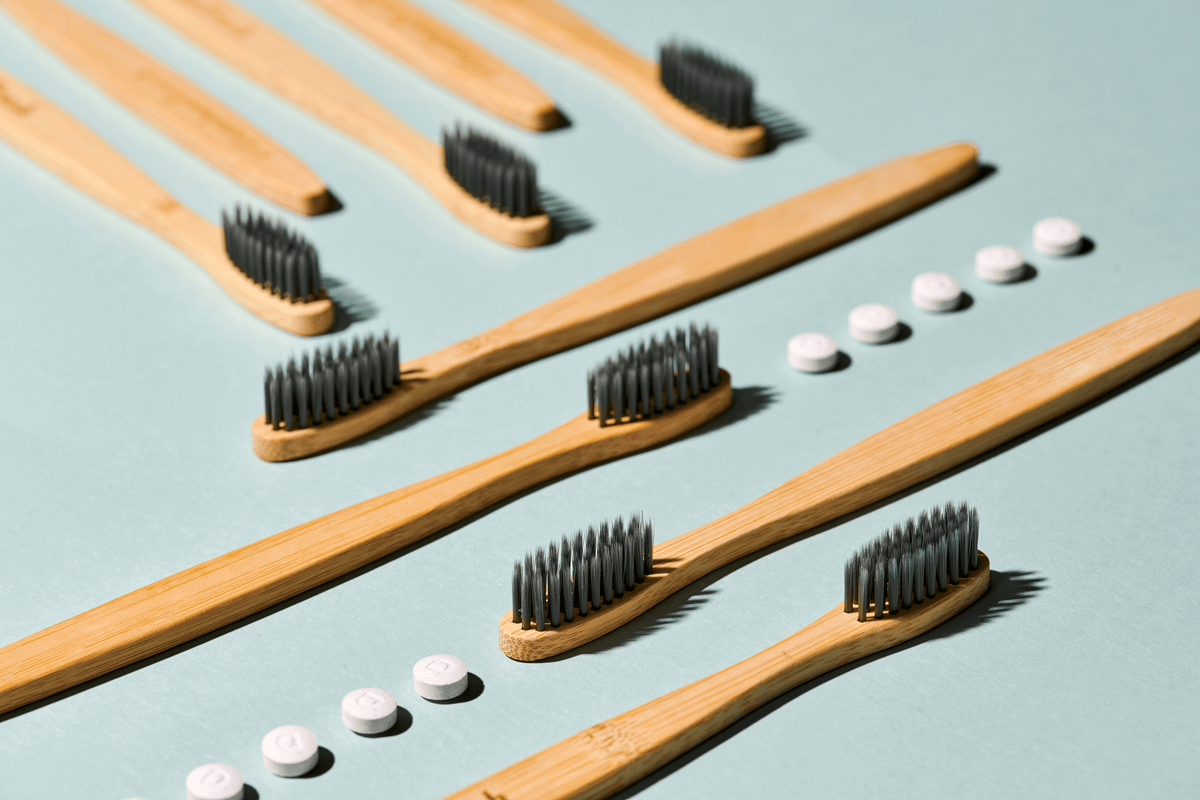
Whether electric toothbrush or manual toothbrush: In principle, it is better for the teeth and gums to use a toothbrush with soft bristles. If you also want to do something for your environment, we can highly recommend our eco-friendly bamboo wood toothbrushes with extra soft bristles.
Bamboo is not only biodegradable but is also one of the fastest-growing plants in the world. Due to its antibacterial and odor-resistant properties, bamboo wood is practically predestined for dental care. The soft and fine bristles of our bamboo toothbrushes, in combination with our tablets, ensure particularly smooth and clean teeth.
Conclusion: Brushing teeth with toothpaste tablets – an alternative to toothpaste?
Quote: "They are only small tablets, but they have the potential to turn an entire industry upside down."
(Prof. Dr. Michael Braungard – Jury member, German Sustainability Award Foundation)
Toothpaste tablets are an environmentally friendly and tooth-gentle alternative to toothpaste. Despite the minimum of ingredients, toothpaste tablets are in no way inferior to conventional tooth creams in terms of brushing and cleaning effect. Also, regarding caries prophylaxis, toothpaste tablets contain sufficient fluoride to be effective against caries. Another great advantage of our tablets is that the teeth are not only cleaned when brushing, but are simultaneously polished by the countless small cellulose fibers.
For those who want to do extra good for the environment and accumulate less plastic waste: The packaging of our climate-neutrally produced toothpaste tablets has been industrially compostable since 2019 and is based on a corn-based bio-plastic. Many good reasons why Denttabs toothpaste tablets were awarded the German Sustainability Award in 2021.
Are you curious now and want to try our tablets?
Click here for our online shop
Speaking of packaging: Don't miss our next blog post!
In it, we report on the plastic waste problem in the specific context of the production and disposal of toothpaste tubes: In Germany alone, around 500 million non-recyclable toothpaste tubes end up in the trash every year.
(© Lisa Asbäck-Kreinz – www.textiererei.com)


Share:
3 Tips for More Courage in Everyday Life
Toothpaste tablets have finally reached the top!